
Search results...
Mediation as a form of ADR
Mediation is a form of ADR (Appropriate Dispute Resolution), a collective term for methods that resolve conflicts without the intervention of a judge. Mediation differs from other ADR forms such as arbitration or conciliation in that it relies entirely on the active commitment of the parties involved.
How does mediation work in practice?
Under the expert guidance of an accredited mediator, the parties work towards a resolution in each other's presence. The process is oral and focused on dialogue, with the mediator acting as a neutral guide to steer the process in the right direction. This ensures that resolutions are not imposed but are worked out together, significantly increasing the likelihood of compliance.

When can you use mediation?
Mediation is possible for different types of conflicts in everyday life:
- Family conflicts such as divorce, custody and inheritance issues.
- Rent disputes between tenants and landlords over contracts or maintenance.
- Neighbour disputes over noise, property boundaries, or shared spaces.
- Problems with purchases or services in disagreements with a merchant or service provider.
- Debt or financial conflicts in which settlement without a court is preferred.
- Youth: school, sports clubs, etc.
Why opt for an accredited mediator?
"Mediator" is not a protected title. Do you want to be sure, however, of a mediation that is legally sound and offers additional safeguards? In such cases, opt for an accredited mediator.
An accredited mediator:
- Has official recognition from the Federal Mediation Commission and has completed a quality training programme. also undertakes mandatory continuing education.
- works to a code of ethics, which guarantees professionalism and neutrality.
- offers the possibility to make a mediation agreement binding and enforceable through court approval.
- can provide citizens with limited financial resources access to free mediation through free public assistance.
Mediators

What does a mediation process look like?
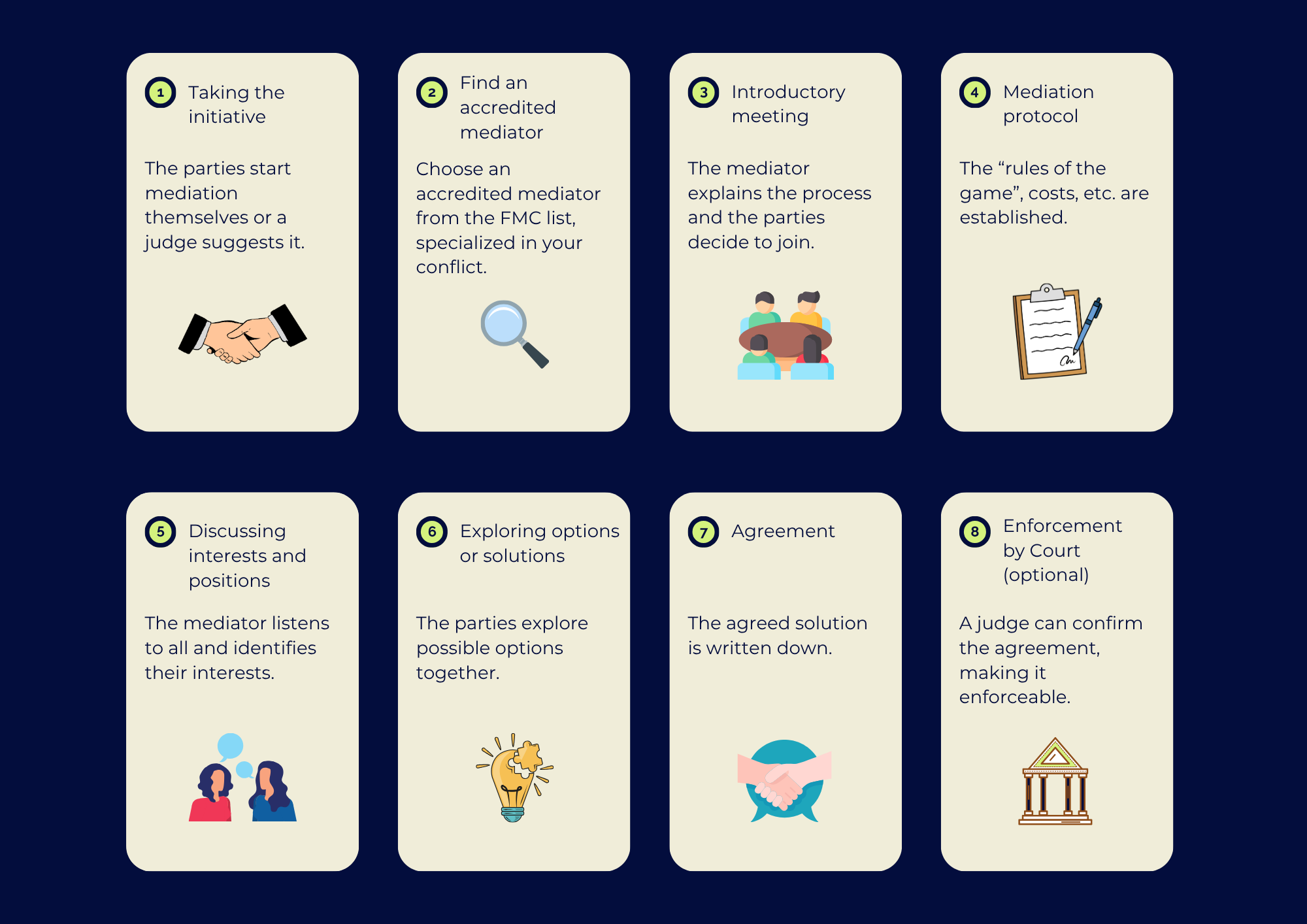
Ask us your question
Do you have questions about mediation or want to know if this is the right solution for your situation? The information you are looking for may already be on our website. Can't find an answer to your question? Please feel free to contact us.


Mediation provides an accessible and efficient way to resolve conflicts. The process is faster and more flexible than traditional procedures and takes the specific needs of all parties into consideration. Working together to reach an agreement can result in a durable resolution supported by all and preserve the relationship between the parties.
1. Efficient and targeted
Mediation offers the opportunity of reaching a resolution in a flexible and targeted way. Parties can shape the process by mutual agreement, which often leads to a quicker resolution.
2. Financially accessible
Mediation allows conflicts to be settled without unexpected or mounting costs. Spending remains transparent and is shared between the parties, contributing to a financially accessible resolution.
For people with limited financial resources, there is also the possibility of receiving pro bono mediation, whereby the costs are fully or partially reimbursed. Read more about pro bono mediation.
What can I do as an employee of the OCMW (Public Centre for Social Welfare) or CAW (Centre for General Welfare Work)?
As a OCMW or CAW employee, you can inform clients about the possibilities of mediation as an alternative to legal proceedings. You can refer them to accredited mediators and support them in preparing for the mediation process.
Consult the official list of accredited mediators.
Off3. Voluntary and confidential
Mediation is done on a voluntary basis. Parties choose this method themselves and can stop at any time. Moreover, all discussions and documents within mediation remain strictly confidential.
4. Preserving the relationship
Resolving conflicts together results in less damage to relationships than pursuing the matter in court. This is especially relevant in family or business conflicts, where preserving the chance of future cooperation is key.
5. Customised resolutions
A judge makes a ruling based on laws and legal frameworks, whereas mediation leaves room for creative and tailor-made resolutions that better suit the specific needs of both parties.
6. Greater compliance with agreements
Agreements reached through mediation are more often respected than court rulings Due to the parties' own involvement in determining the resolution, they also feel more committed to the outcome.
7. Emotionally less stressful
Mediation provides a safe environment where all parties are heard in a respectful manner. This reduces the stress and emotional strain associated with conflict.
8. Court approval
The parties can choose to have their agreement approved by a judge. This gives it the same legal value as a judgement and makes it enforceable if one of the parties does not comply with the agreements.