
Search results...
Advantages of accreditation
- Legal validity: Accredited mediators can have mediation agreements approved by the court, giving them the same legal force as a judgement.
- Professional accreditation: Recognition by the FMC confirms your competence and reliability as a mediator.
- Access to networks: You will be included in the official list of accredited mediators, increasing your visibility and access to professional networks.
Frequently asked questions and contact
Still have questions about the accreditation procedure or another, related topic? If so, consult our frequently asked questions page or contact us directly.

How is the term “mediator” used in a Dutch-speaking context?
In Dutch, the term “mediator” is used as a synonym for bemiddelaar. It is more commonly used in the Netherlands, but it refers to the same role: a neutral person who assists the parties in reaching an agreement.
Off
Mediation is a voluntary and confidential way to resolve conflicts with the help of an independent mediator. It is a structured process in which a neutral third party helps reach a joint resolution that takes the interests of all parties into account. The mediator does not make decisions, but guides the conversation and ensures a constructive negotiation.
Uses of Mediation
Mediation is often used in family disputes, business conflicts, conflicts concerning neighbours and social or work-related issues as well as in disputes with the government. Mediation is a more effective and compassionate alternative to lengthy litigation, emphasising dialogue and cooperation.




Learn more about mediation
Click on a theme to find out more:
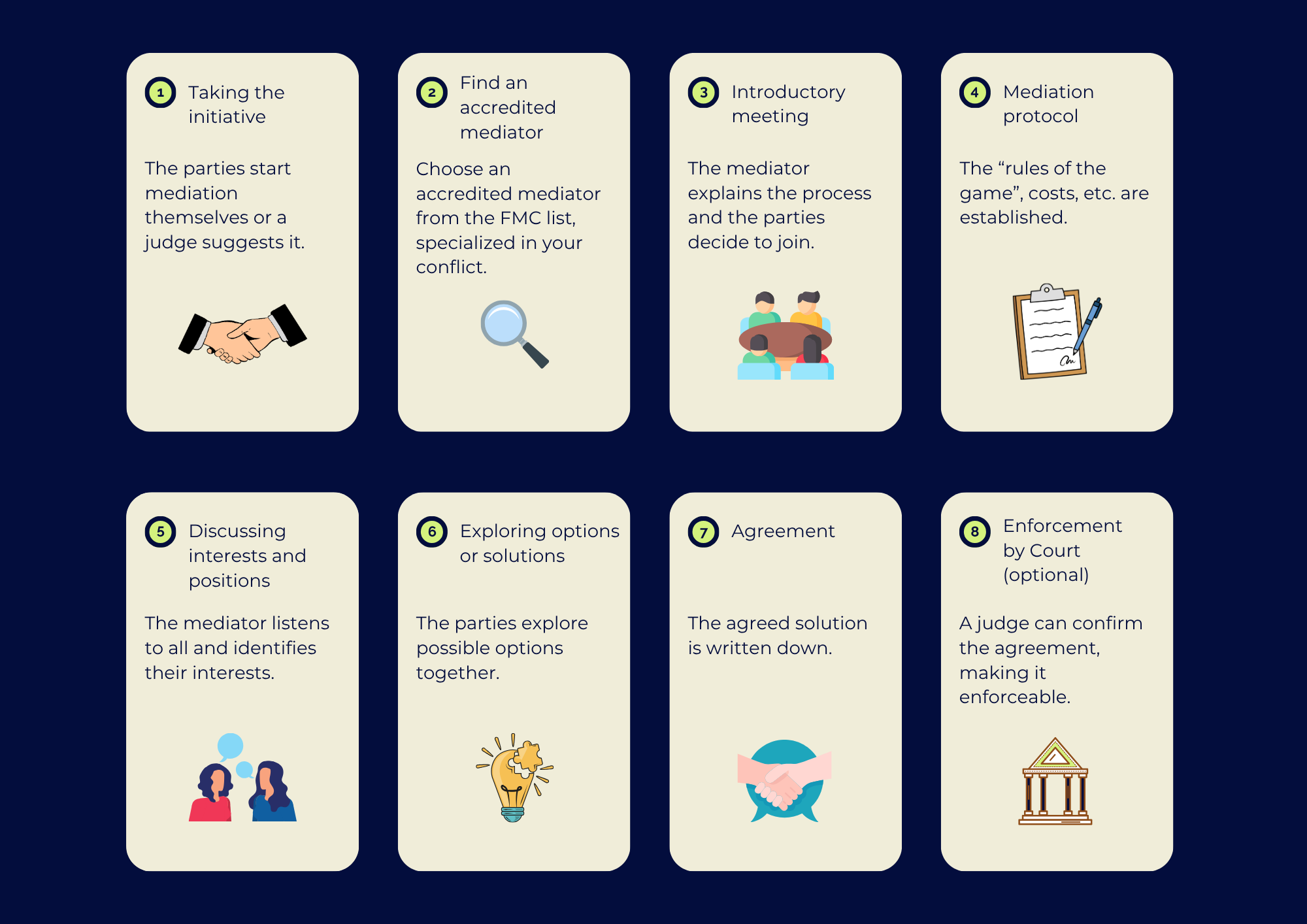
The mediation process
What does mediation cost?
The cost of mediation varies and is usually shared by the parties involved. There are no fixed prices. Contact a certified mediator to obtain a specific amount. Mediation is often a cost-effective way to resolve disputes compared to traditional court proceedings.
You can find more details on our page about the costs of mediation.
Individuals with no income or with an income below a certain threshold can make use of free or partially free legal assistance. Another term for this is “pro bono mediation”.
You can read more details on our pro bono mediation page.
Off
Find an accredited mediator
Are you looking for a mediator to help you with your conflict? Use the search function in our online database to find a certified mediator in your area and/or one who specialises in your situation. Any questions? Contact us to find out how mediation can help you.
Continuing Professional Development enables training centres to contribute to the continuing professional development of mediators. The Federal Mediation Commission (FMC) grants accreditation to training courses that are relevant and of high-quality in the mediation sector. Accreditation from the FMC acts as a seal of quality and confirmation that a course meets the established standards, and accreditation of a course counts towards the mandatory training hours of mediators.
Application for FMC course accreditation
Training centres and individual instructors seeking to have their courses accredited as continuing professional development can submit an application to the FMC. The accreditation procedure involves the submission of a file, review by the Development Commission and a final decision by the FMC.
The criteria and guidelines that a course must meet, as well as the application form, can be found here:
Please feel free to contact us
All accreditation application guidelines and documents are available in the documentation. For further questions, please contact the secretariat of the Federal Mediation Commission through the contact page.

How does mediation work?
The mediator questions and listens to the views of the parties. By doing so, their interests are brought to light. The mediator helps the parties translate their interests into options, which enables them to reach an agreement.
Off